
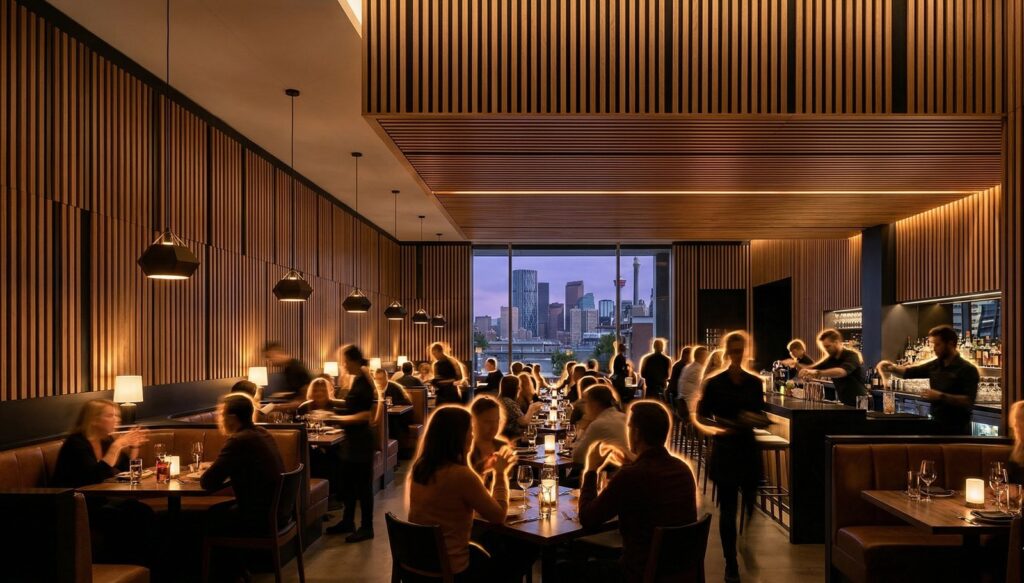
If you’ve ever sat in an open-plan office trying to focus while three conversations compete for your attention, or abandoned a restaurant because you couldn’t hear your dinner companion — you’ve experienced what acoustic engineers call excessive reverberation. The fix isn’t louder voices or noise-cancelling headphones. It’s acoustic wall panels.
We install acoustic panels as part of our commercial wallcovering services across Calgary. Here’s what you need to know before investing.
Why Hard Surfaces Create Noise Problems
Modern interiors love hard surfaces. Polished concrete, floor-to-ceiling glass, exposed ceilings, minimalist drywall — they look clean and contemporary, but they reflect sound instead of absorbing it. Every voice, phone call, and keyboard click bounces off these surfaces and accumulates into a wall of background noise.
Acoustic professionals measure this as reverberation time (RT60) — the time it takes for sound to decay by 60 decibels. In a typical open office with hard surfaces, RT60 can exceed 1.5 seconds. For comfortable speech intelligibility, you want it under 0.8 seconds. The difference is dramatic — it’s the difference between straining to hear and effortless conversation.
How Acoustic Panels Work
Acoustic panels absorb sound energy instead of reflecting it. The panel’s core material — typically compressed PET felt, mineral wool, or fibreglass — converts sound waves into tiny amounts of heat through friction. The thicker and denser the core, the more low-frequency sound it absorbs.
Panel performance is measured by the Noise Reduction Coefficient (NRC), a scale from 0 (perfect reflection) to 1.0 (perfect absorption). Most commercial acoustic panels rate between 0.7 and 1.0 NRC, meaning they absorb 70–100% of the sound that hits them.
Materials We Install
Not all acoustic panels are grey foam squares. The modern acoustic market offers materials that look like intentional design choices:
- Wood slat panels — natural oak, walnut, and painted finishes with acoustic felt backing. The most popular choice for Calgary offices and restaurants right now. They deliver warmth and texture while absorbing mid-to-high frequency sound.
- PET felt panels — made from recycled polyester in 40+ colours. Lightweight, easy to customize into shapes and patterns, and excellent NRC (0.8–0.95). Great for creative offices and modern interiors.
- Fabric-wrapped absorbers — fibreglass or mineral wool cores wrapped in designer fabrics (Guilford of Maine, Camira, or custom). The workhorse of commercial acoustics — used in boardrooms, lecture halls, and healthcare.
- Micro-perforated wood veneer — real wood veneer with laser-drilled micro-holes backed by an acoustic core. Sound passes through the holes and is absorbed by the backing. Invisible acoustic treatment that looks like a premium wall finish.
- Acoustic wallcoverings — textile-backed vinyl with sound-dampening cores that install like regular wallcovering. Ideal when you want acoustic performance without visible panel edges.
How Much Coverage Do You Need?
A common mistake is covering every wall — you don’t need to. As a general guideline:
- 25–40% wall coverage — noticeable improvement for most offices and restaurants
- 40–60% coverage — significant improvement for critical spaces (boardrooms, studios)
- Strategic placement matters more than total area — panels at first reflection points (the walls directly opposite speakers) have the most impact
For complex projects, we calculate exact requirements based on your room dimensions, existing surfaces, ceiling height, and acoustic goals.
Cost Ranges
- PET felt panels: $12–$20/sq ft installed
- Wood slat systems: $25–$45/sq ft installed
- Fabric-wrapped absorbers: $15–$35/sq ft installed
- Acoustic wallcoverings: Priced per linear yard, similar to Type II vinyl
All prices include layout planning, mounting hardware, and precision installation. Material cost varies by manufacturer and finish selection.
Fire Rating and Building Code
All acoustic panels we install for commercial projects are Class A fire-rated, meeting Canadian building codes for offices, healthcare, education, and hospitality. We provide manufacturer documentation for building inspectors and permit applications.
Our Installation Process
Acoustic treatment isn’t just mounting panels — it’s engineering sound for your specific space. Our process:
- Acoustic assessment — we evaluate your space’s dimensions, surfaces, and noise sources
- Design and layout — panel placement for maximum absorption and visual impact
- Precision installation — laser-levelled mounting with consistent spacing and seamless edge alignment
Every panel is plumb, every gap is uniform, and every surface is protected during installation — the same standard we hold for all our commercial wallcovering work.
If noise is costing your business productivity or customers, reach out for a free acoustic assessment. We’ll evaluate your space and recommend a solution that fits your budget and design goals.