
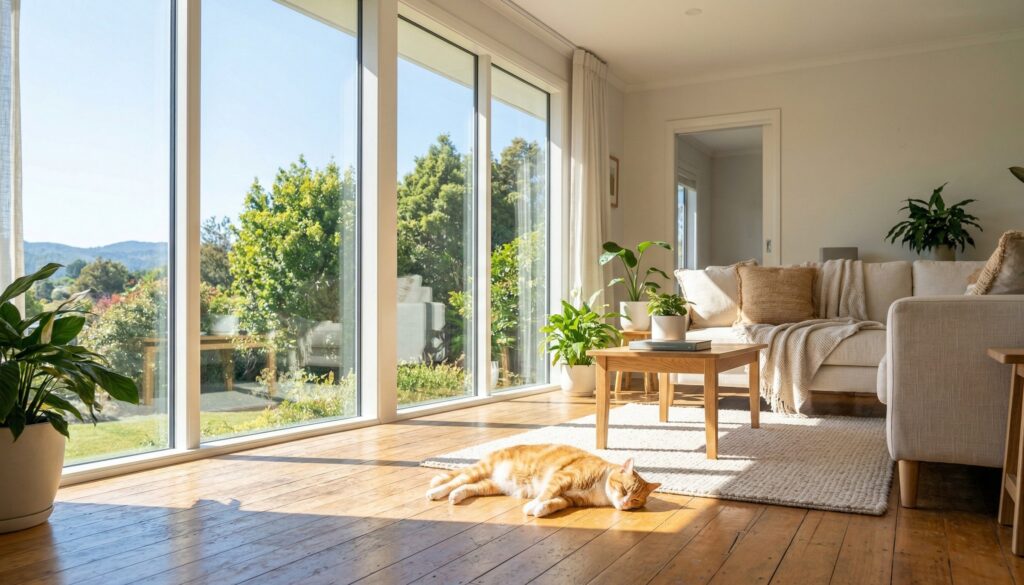
Every Calgary summer in the last decade has brought another stretch of 30+ °C days, longer heat waves, and more south-facing living rooms that feel like a sauna by late afternoon. With forecasts pointing to another warm-trending season, homeowners and facility managers are asking the same question: what actually stops the heat, and what’s marketing?
This guide compares the three film technologies we install most — ceramic, dual-reflective, and dyed — on the numbers that matter for Calgary: total solar energy rejection, UV blocking, visibility, glare cut, and cost per square foot. If you’ve been quoted “window tint” without specs, this is the framework for pushing back.
The Four Numbers That Actually Matter
Every reputable film manufacturer publishes a spec sheet. The four numbers to look at:
- TSER (Total Solar Energy Rejected) — the headline heat number. 40% is good, 55% is excellent, 70% is top-tier. This is the single most important figure.
- UV Rejection — modern films should all be 99%+. Anything less is outdated.
- Visible Light Transmission (VLT) — how much daylight comes through. 50%+ for residential (you want the view), 35%+ for commercial with heavy sun.
- Glare Reduction — percentage of direct glare cut. Anything 30%+ is immediately noticeable on screens.
Ignore marketing claims like “advanced nano-layering” unless the spec sheet backs them.
Ceramic Films: The Residential Sweet Spot
Ceramic window films use a layer of microscopic ceramic particles — not metal, not dye — to reject infrared heat. The benefit is that they reject 80–95% of infrared (the part of sunlight you feel as heat) while staying essentially clear.
Typical specs on a high-quality residential ceramic like 3M Prestige or Llumar CTX:
- TSER: 45–60%
- UV rejection: 99.9%
- VLT: 50–70% (depending on tier)
- Glare reduction: 40–50%
What it’s right for: Calgary homes where the homeowner doesn’t want a tinted look, has picture windows with a view to preserve, and cares about fade protection for hardwood floors, art, or upholstery. Also the best option when spouses disagree on whether to “tint” the windows — ceramic is nearly invisible from inside and outside.
Cost range: $9–15 per sq ft installed in Calgary for residential glass.
Real-World Install Example
A recent Aspen Woods install: 22 south- and west-facing windows on a walk-out bungalow, totalling ~280 sq ft of glass. Ceramic film spec’d at 55% TSER and 99% UV. The homeowner reported the upstairs bedroom was 4 °C cooler by mid-afternoon in week one of the next heat wave, and their main-floor media room stopped needing the blinds closed to watch a laptop. A/C cycling on their Ecobee dropped roughly 18% during hot hours compared to the pre-install week.
Dual-Reflective Films: Bigger Glass, Bigger Numbers
When the job is a west-facing wall of windows, a full-height south exposure, or a commercial storefront with heavy afternoon sun, dual-reflective film takes the heat numbers higher than ceramic can.
Typical specs:
- TSER: 60–75%
- UV rejection: 99.9%
- VLT: 20–50%
- Glare reduction: 55–75%
The tradeoff: it has a mild reflective appearance from outside during daylight (reverses at night, when indoor lights make it look like a regular dark window from outside). For commercial glass this is usually a non-issue or actively desirable — it looks cleaner. For residential it depends on the look of the home.
Cost range: $8–12 per sq ft installed in Calgary for typical residential/commercial glass.

Dyed Films: Why We Rarely Install Them Anymore
Dyed window films — the old-school “automotive-style” tint — still show up in cheaper quotes. They look fine on day one but have three problems that matter in Calgary:
- They fade. Dye in film breaks down under UV. Expect a purple, brown, or uneven look within 3–5 years.
- Weak heat rejection. Dyed films typically top out at 25–35% TSER — less than half a ceramic film. You’ll feel the difference on a 32 °C day.
- Shorter warranty. Manufacturer warranties on dyed film are usually 5 years vs. lifetime on ceramic.
For Calgary’s sun-hours and temperature swings, dyed film is not economical — the $1–3/sq ft saved up front disappears the first time it has to be replaced.
Matching Film to Room, Not House
The cheapest mistake we see: picking one film for the whole house. Different exposures need different films:
- North-facing glass: rarely needs heat film. UV/fade protection at most.
- East-facing glass: morning sun, mild heat load. Ceramic with higher VLT.
- South-facing glass: year-round sun, moderate heat load. Ceramic is ideal (keeps winter solar gain, cuts summer peak).
- West-facing glass: afternoon heat bomb. Dual-reflective or high-performance ceramic.
We zone film selections by exposure as part of the free in-home consultation. A blanket quote at one film spec usually means the installer hasn’t walked the house.
What a Free Calgary Quote Should Include
- Specific film model per window group (not “ceramic” — the actual product, e.g., 3M Prestige 70 or Llumar AIR 80).
- TSER, UV, VLT, and glare numbers for each specified film.
- Manufacturer warranty term (lifetime for ceramic tier; 10+ years for reflective).
- Installer warranty on workmanship (we warrant ours for 10 years).
- Square footage of glass broken out by exposure.
- Whether the quote is for single-pane, double-pane, or triple-pane glass (spec differs).
If any of those are missing, push back — that’s what we cover in our quotes by default.
Book Before July
Our Calgary install schedule fills out by mid-May every year. Booking in April or early May means you pick the week and get the film on the glass before peak summer heat arrives. By the time Environment Canada issues the first heat warning, your living room is 4–6 °C cooler than last year on the same afternoon.
Compare our solar films or request a free quote. We cover Calgary, Airdrie, Chestermere, Okotoks, Cochrane, and Red Deer — and every install is backed by a 10-year workmanship warranty.