
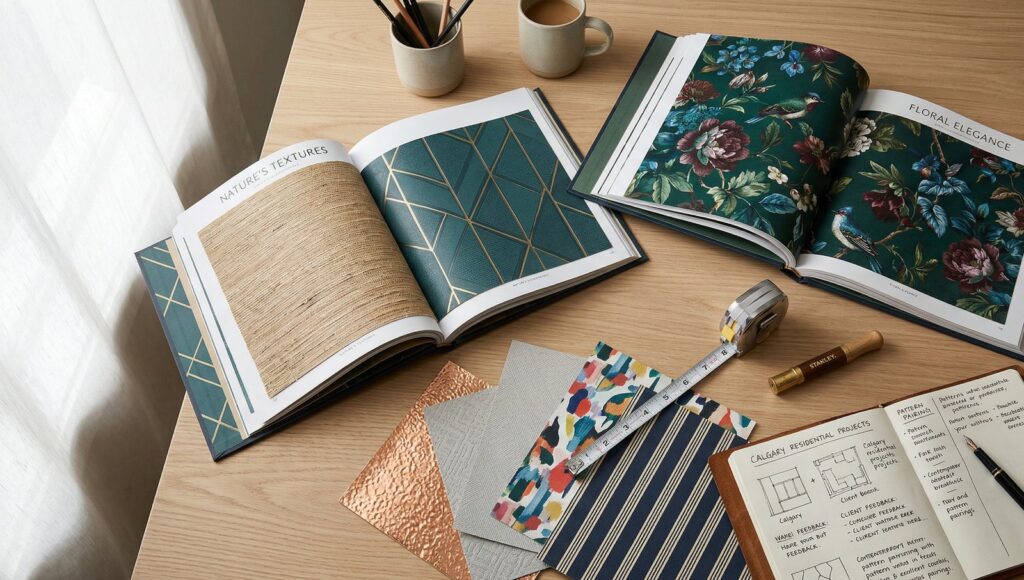
Paint can change the colour of a room. Wallpaper can change the whole feeling of it.
That difference is obvious when you look through a collection like HUE. The catalogue is not built around one pattern or one trend colour. It is organized into coordinated series, with numbered options across groups like 24201, 24202, 24203, 24204, 24205, 24206, 24207, and 24208. That kind of structure is exactly why wallpaper is so useful: it gives designers and homeowners a controlled way to compare scale, rhythm, contrast, and mood before anything goes on the wall.
For Calgary homes, condos, show homes, offices, restaurants, and retail spaces, wallpaper is not just decoration. It is a finish material that can define a room faster than furniture, lighting, or paint alone.
Wallpaper Adds Depth That Paint Cannot
A flat paint colour reads as one surface. Even a beautiful colour still depends on furniture, art, and lighting to create dimension. Wallpaper brings that dimension into the wall itself.
Pattern, texture, sheen, and repeat all work together. A soft tonal wallpaper can make a primary bedroom feel finished without becoming busy. A stronger geometric or organic pattern can turn a plain powder room into the most memorable room in the house. A commercial vinyl wallcovering can make a reception wall look intentional instead of temporary.
That is the real reason wallpaper keeps coming back: it does visual work that paint cannot do by itself.

A Collection Makes Design Easier
One of the strongest things about a catalogue-style collection is that it narrows the decision without making the room feel generic. Instead of starting with thousands of unrelated samples, you can compare related options inside the same visual family.
That matters on real projects. A homeowner may love a bold pattern online, then realize in the room that the repeat is too large for the wall. A designer may need a quieter coordinate for an adjoining hallway. A builder may need several options that feel connected across a show suite without repeating the exact same paper everywhere.
Collections like HUE solve that problem by grouping patterns in a way that lets you move from subtle to expressive while keeping the palette and design language under control.
Wallpaper Helps a Room Commit
The best rooms usually have a clear point of view. Wallpaper is one of the fastest ways to create that.
- Powder rooms can handle drama because the room is small, enclosed, and meant to feel special.
- Dining rooms benefit from texture, warmth, and pattern that make the room feel complete even when the table is not set.
- Bedroom feature walls can replace oversized art and create a softer backdrop behind the headboard.
- Entryways can make the first ten seconds inside a home feel more considered.
- Commercial lobbies and corridors can carry brand tone without relying on signage alone.
Paint can make these spaces cleaner. Wallpaper can make them feel designed.
It Is Also More Practical Than People Remember
A lot of wallpaper hesitation comes from memories of old border strips, difficult removal, and seams lifting in older homes. Modern wallpaper and professional installation are a different conversation.
Today, the practical result depends on three things: choosing the right material, preparing the wall correctly, and installing with the right adhesive and technique. A delicate residential paper, a natural grasscloth, and a Type II commercial vinyl all behave differently. The wall prep, primer, booking, trimming, and seam strategy should change with the material.
That is where professional installation matters most. Good wallpaper is not just hung straight. It is planned. The starting point is chosen so the eye catches the right part of the pattern. Corners are managed so the repeat does not drift. Out-of-plumb walls are accounted for before the first strip is on the wall. Seams are rolled with the correct pressure for the product, not crushed into place.
The Right Wallpaper Is Chosen for the Room
There is no single best wallpaper. There is a best wallpaper for the wall, the lighting, the traffic level, and the goal of the room.
In a bright Calgary home with large windows, a pattern that looks calm in a sample book may become more active in afternoon sun. In a basement office, a darker or more textured paper may add the warmth the room is missing. In a commercial hallway, cleanability and impact resistance may matter more than the most delicate finish.
That is why sample review should happen in the actual space whenever possible. Look at the paper in morning light, evening light, and artificial light. Hold it vertically, not flat on a table. Consider the furniture, flooring, trim colour, and nearby rooms. Wallpaper is a surface you live with at full scale, so it should be judged at full context.
Why Wallpaper Is Worth It
Wallpaper earns its place when the room needs more than a colour change. It can add depth, rhythm, softness, contrast, luxury, brand personality, or a clear focal point. It can make a builder-basic wall feel architectural. It can make a small room feel intentional. It can help a commercial space feel less temporary and more established.
The HUE catalogue is a good reminder of that. A wallpaper collection is not just a stack of pretty patterns. It is a design tool, built to help you choose the level of movement, contrast, and mood that belongs in the room.
Planning a Wallpaper Project in Calgary
If you are choosing wallpaper for a feature wall, powder room, office, show suite, or commercial space, start with the room first and the pattern second. Measure the wall, check the lighting, decide how bold the room should feel, then narrow the sample options from there.
Wall Style Innovations installs residential wallpaper, murals, grasscloth, and commercial wallcoverings across Calgary, Airdrie, Chestermere, Cochrane, Okotoks, and Red Deer. We can review samples, confirm quantities, prepare the wall, and install the material with clean seams and proper pattern alignment.
Explore wallpaper installation or request a free quote.